

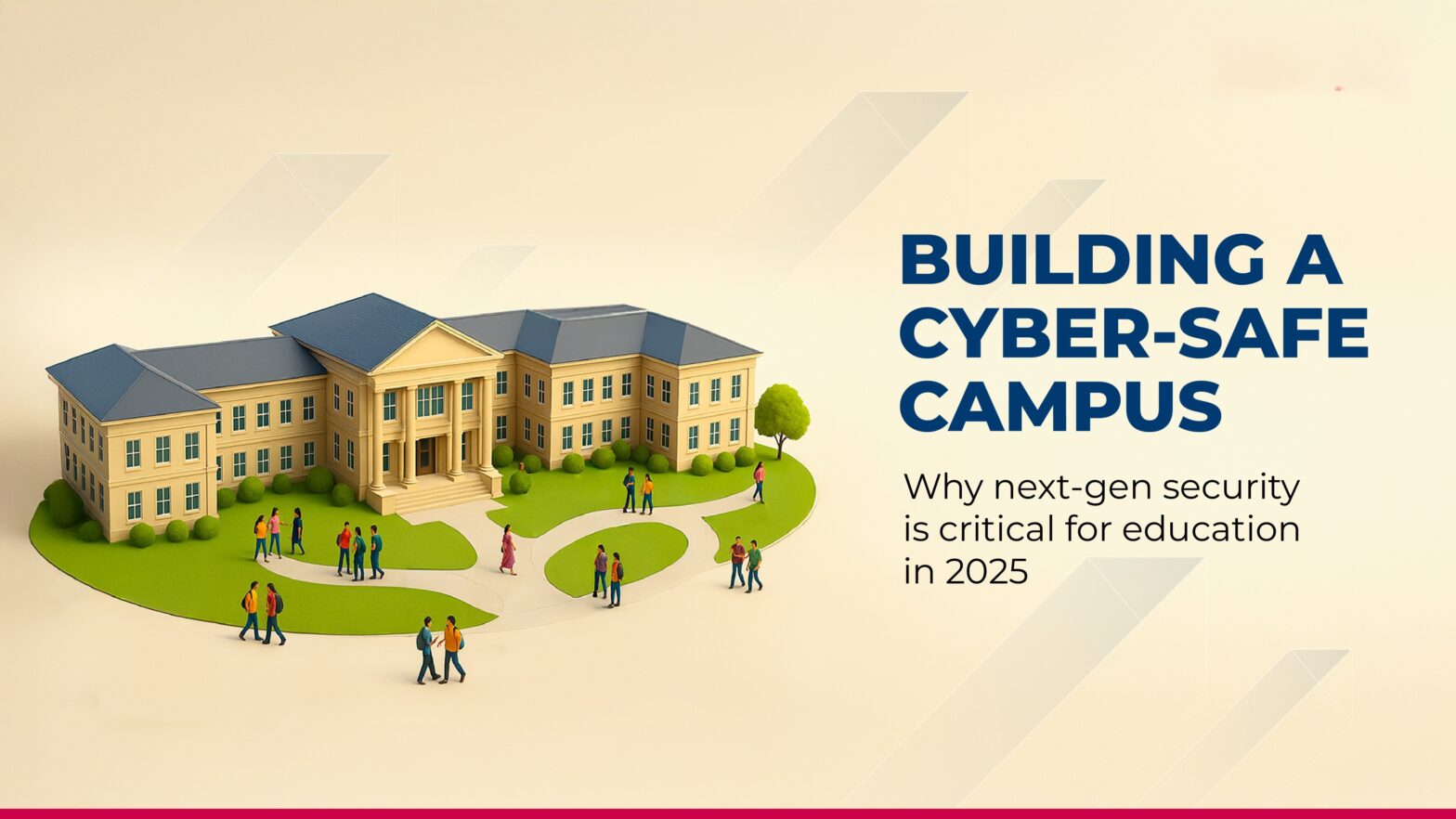
Building a Cyber-Safe Campus: Why Next-Gen Security Is Critical for Education in 2025
September 5, 2025
Today’s educational institutions are more than centers of learning. They have become dynamic digital ecosystems. With the surge in bring-your-own-device (BYOD), cloud-based platforms, and AI-driven teaching tools, campuses are full of promise and increasingly vulnerable to cyber threats.
The Growing Industry Threat: Ransomware and Data Breaches on the Rise
In recent months, ransomware attacks on universities, colleges, and private institutes have escalated rapidly. Educational data is highly sensitive, and campus networks often lack cohesive protection.
- Ransomware attacks on universities, colleges, and private institutes rose 23% globally in the first half of 2025.
- Around 130 ransomware incidents targeted higher education during this period.
- Average ransom demand was close to ₹4.63 crore.
- Higher education ranked as the fourth-most targeted sector, after business, government, and healthcare.
- 61% of IT leaders in universities and private institutes reported ransomware attacks in the past year.
- Nearly 40% of ransomware detections were in higher education.
- Over 85% of attacks exploited compromised credentials, phishing emails, or unpatched systems.
- 65%+ of universities lack basic email security configurations, increasing vulnerability.
Examples of rising threats:
- Real-world incidents where several universities were taken offline during exam periods, with attackers demanding ransoms to restore access.
- Every student and staff member bringing multiple devices increases entry points for attackers. Password-based Wi-Fi is no longer sufficient.
- The shift to hybrid learning has increased traffic loads beyond what legacy systems can monitor or secure effectively.
- New privacy laws mandate protection of personal, biometric, and academic data. Institutions risk legal and reputational fallout if they fail to comply.
Where Conventional Security Falls Short
Despite the rapid evolution of digital learning tools, many educational institutions continue to rely on outdated security frameworks, leaving them exposed to critical risks.
- Fragmented network tools that prevent full visibility across digital infrastructure.
- Security teams are overloaded with manual incident response instead of proactive threat prevention.
- Lack of role-based access controls, making it easy for credentials and data to be exposed.
The Solution: Proactive Managed Security for Learning Environments
Securing campuses today requires a purpose-built approach grounded in modern technology and education-specific needs.
Essential components include:
- Enterprise-grade encryption powered by WPA3, automated certificate management, and secure device authentication.
- 24/7 AI-driven monitoring to detect suspicious activity, isolate threats, and inform IT staff before disruption occurs.
- A unified dashboard for centralized management of security policies across all campus sites.
- Network segmentation to separate student, staff, and guest traffic, preventing cross-device contamination.
- Automated logs and audit trails to meet compliance standards confidently.
Securing the Future of Campus Connectivity
At iBUS, we understand that secure, reliable connectivity is no longer a luxury; it’s a necessity.
That’s why we deliver Managed Wi-Fi through Microsense, an iBUS enterprise, ensuring campuses stay seamlessly connected across classrooms, hostels, and common areas. We continue to fortify the digital infrastructure of educational institutions with solutions designed to be both secure and future-ready.
For us, it’s not just about keeping people online; it’s about building a foundation for smarter, safer, and more connected campuses.
Our impact includes
- Uptime rates of 99.9 percent powered by AI-based threat detection.
- End-to-end encryption to protect personal and institutional data.
- Simplified operations with centralized control across all locations.
- Cost-effective scalability through pay-as-you-go operating models.
Cybersecurity is no longer just a technical requirement, it is the foundation of trust and resilience in a digital learning environment. Institutions that act now will be equipped not only to protect their students but also to lead confidently into the future of education.
Related Posts



September 5, 2025
You have planned the classrooms, the courtyards, the curriculum. But what about the bandwidth?